How Big Is the Pickleball Kitchen?
Many pickleball players struggle to understand exactly where the kitchen begins and ends, especially when choosing gear or learning the rules. You’re not alone—knowing its measurements and boundaries can make a big difference in your game.
How Big Is the Pickleball Kitchen?
The pickleball kitchen is a 7-foot-deep zone on each side of the net, spanning the court’s full 20-foot width. That makes each kitchen 140 square feet, measured from the net toward the baseline.
The kitchen includes its boundary line, so you can’t touch the line during a volley without committing a fault. You may stand or move inside it after a bounce, but you can’t volley there.
Continue for details on measuring, serving, rules, and strategy.
Key Takeaways
- The pickleball kitchen extends 7 feet from the net toward each baseline.
- It spans the court’s full 20-foot width between the sidelines.
- Each kitchen measures 20 by 7 feet, covering 140 square feet.
- The kitchen includes its boundary line, measured from the net’s plane.
- Players may enter the kitchen but cannot volley while touching the zone or its line.
How Big Is the Pickleball Kitchen?
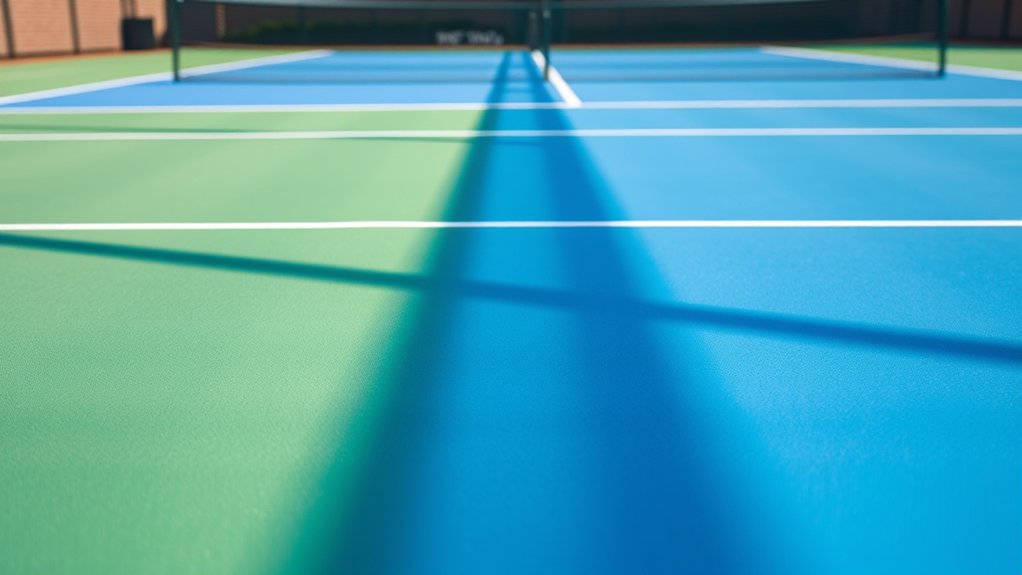
The pickleball kitchen is a 20-foot-wide non-volley zone that extends 7 feet from the net on both sides of the court. Its total area measures 140 square feet, assuming standard court dimensions. You’ll find this zone across the court’s full width, creating a clearly defined space near the net where specific shot rules apply.
When you assess kitchen size, use the court’s official 20-by-44-foot layout as your reference. The kitchen accounts for the central 7 feet on each side, while the remaining court length supports baseline and smooth play. Accurate measurements help you position pickleball equipment correctly, including temporary nets, boundary markers, and court tape.
For reliable Court maintenance, inspect the kitchen lines regularly. Faded paint, loose tape, or surface damage can make the area difficult to identify and may affect play. Keep the surface clean, level, and free from cracks so you can move safely and recognize the kitchen’s limits during every game.
Where Does the Kitchen Start and End?
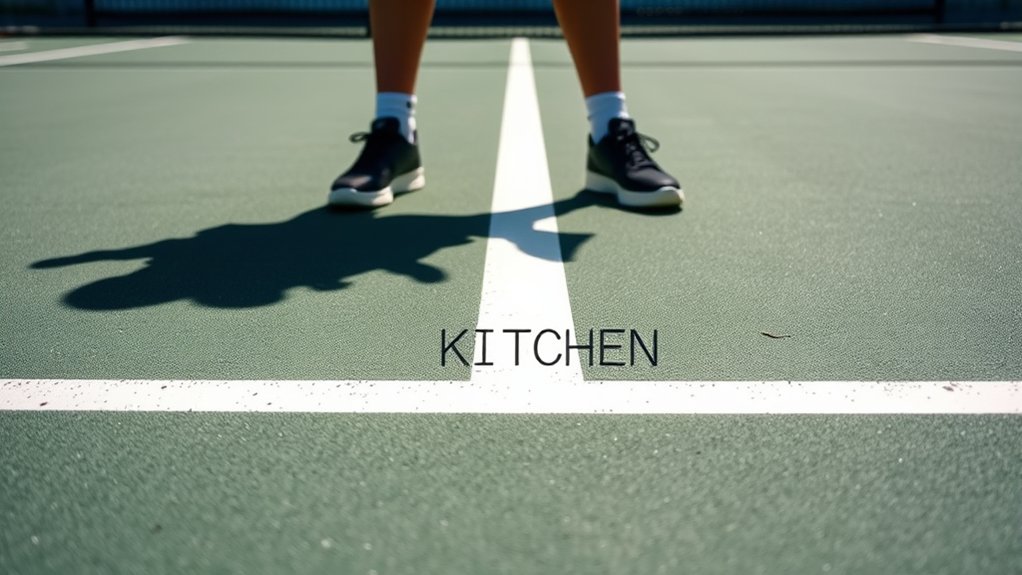
You’ll identify the kitchen by its boundary lines, which show where the non-volley zone begins and ends. The kitchen line is 7 feet from the net on each side. Once you understand these markings, you’ll know where the kitchen starts and stay within the correct playing area.
Kitchen Boundary Lines
Where does the kitchen start and end? You’ll find this non-volley zone between the net and the kitchen line on each side. The line itself belongs to the kitchen, so touching it while volleying creates a fault.
The net separates both kitchens, while the sideline ends each kitchen’s width. Keep these boundaries clear during play, and you’ll make calls confidently without confusing nearby court markings.
| Boundary | What it means |
|---|---|
| Net | Divides both kitchens |
| Kitchen line | Belongs to the kitchen |
| Sideline | Marks the side edge |
Your kitchen awareness also supports player etiquette. Avoid stepping into the zone before your volley, and respect your opponent’s space when moving near the line.
Although kitchen aesthetics can make court markings attractive, accurate, visible lines matter most. Watch your feet, recognize the boundary, and let the markings guide every kitchen decision.
Measuring the Kitchen Area
To measure the kitchen, start at the net and extend 7 feet toward the baseline on each side. This 14-foot-deep area spans the court’s full 20-foot width.
The net divides the kitchen uniformly, so each side measures 7 feet from the net to its non-volley line. Include the boundary line in the kitchen; stepping on it counts as entering the zone.
Use these checks to mark it accurately:
- Measure 7 feet from the net, not the baseline.
- Mark both sidelines before drawing the line.
- Keep the kitchen line parallel to the net.
- Confirm the court remains 20 feet wide.
- Recheck measurements before painting.
You won’t need Kitchen decor or Lighting fixtures to define this playing area, but clear markings improve visibility.
Use durable court tape or paint, and measure from the net’s plane for consistent results.
What Are the Kitchen’s Official Dimensions?
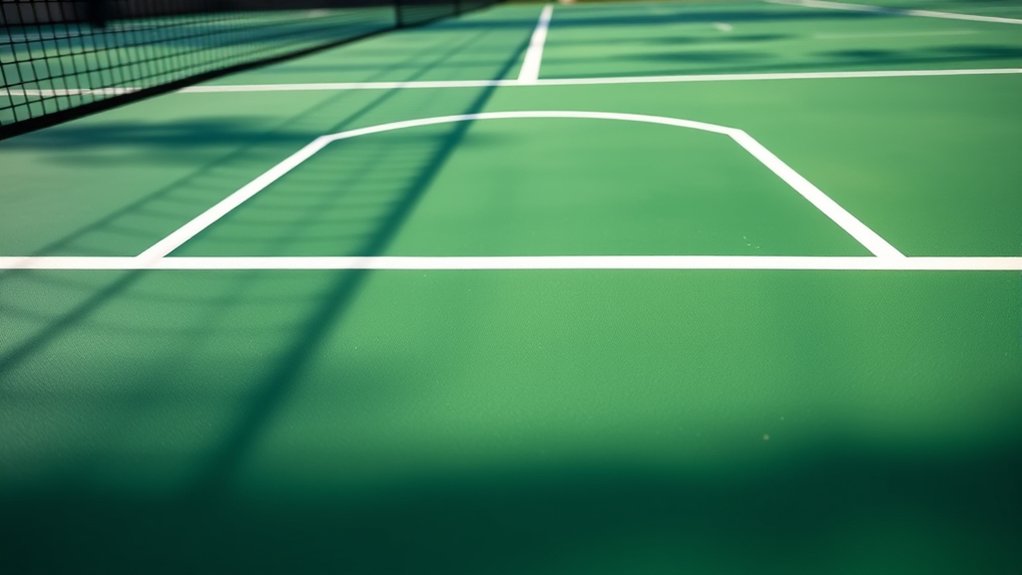
The pickleball kitchen measures 7 feet deep from the net on each side, extending the full 20-foot width of the court. When you stand at the baseline and look toward the net, the non-volley zone occupies the first 7 feet on your side.
Its dimensions remain consistent on indoor and outdoor courts, although the court surface may differ.
| Measurement | Official size |
|---|---|
| Kitchen depth | 7 feet |
| Court width | 20 feet |
| Kitchen width | 20 feet |
You’ll find the kitchen’s depth measured perpendicular to the net, while its width runs parallel to it. This gives you 140 square feet of space on each side.
The area is designed to limit aggressive volleys near the net, so you’ll need controlled footwork and a steady Pickleball paddle.
Use a tape measure when checking a recreational court, and verify that the net sits centered across the full width.
Consistent measurements help you practice accurately and play under standard regulations wherever you compete.
Does the Kitchen Include the Line?
Yes. The kitchen includes its line. In pickleball, the non-volley zone extends from the net to the outside edge of the line, so the line itself belongs to the kitchen. If your foot touches that line while volleying, you’ve committed a fault.
The kitchen includes its line, and touching it while volleying results in a fault.
You may stand on the line when you’re not volleying, but you can’t hit a volley until both feet are completely outside the kitchen and its boundary.
Keep these points in mind:
- The line counts as kitchen space.
- A line touch during a volley is a fault.
- You may enter the zone to play a bounce.
- You must exit before volleying.
- Your partner’s position doesn’t change the rule.
Clear markings support good Kitchen aesthetics and help you recognize the boundary instantly. Smart Equipment placement also keeps bags, paddles, and water bottles away from the playing area, preventing confusion around the line.
How Do You Measure a Pickleball Kitchen?
Measure the pickleball kitchen from the net to the outside edge of the non-volley-zone line: it should extend 7 feet on each side of the net, creating a 14-foot total depth. Use a tape measure for accuracy, keeping it straight and parallel to the court’s sidelines.
Start at the net’s vertical plane, not its supporting posts, and measure outward toward each non-volley-zone line. Mark both endpoints clearly, then confirm that the lines run the full width between the sidelines.
When checking an existing court, measure from the playing surface rather than from raised edges or nearby fencing. Include the line’s width in your measurement by using its far edge; this approach keeps your dimensions consistent with official markings.
Accurate measurements support fair play and good Pickleball etiquette, since every player can trust the boundaries. They also simplify Court maintenance: clear measurements help you repaint faded lines in their correct positions and preserve a reliable playing surface for every game.
How Is the Kitchen Different From the Court?
The kitchen is the 7-foot area on each side of the net, marked by clear boundary lines. Unlike the rest of the court, it restricts volleys, so you’ll need to adjust how you approach the net. Once you understand the differences between the kitchen and the rest of the court, you’ll know how to play each area more effectively.
Kitchen Size And Boundaries
The pickleball kitchen is the 7-foot-wide area on each side of the net, extending from the net to the non-volley line. You’ll recognize its boundaries by the non-volley line, which runs parallel to the net and marks the kitchen’s outer edge.
The net forms the inner boundary. These lines count as part of the kitchen, so your feet can’t touch them when you volley.
- It measures 7 feet deep.
- It spans the court’s full width.
- The net creates its front boundary.
- The non-volley line marks its back boundary.
- Kitchen aesthetics can support player comfort.
You must let the ball bounce before volleying inside this zone. Afterward, you may stand there, but you can’t volley until the ball bounces.
Clear boundary lines help you judge positioning, control movement, and avoid faults during fast exchanges at the net.
Court Area Differences
Unlike the rest of the pickleball court, the kitchen restricts volleys and requires the ball to bounce before you hit it from inside the zone. This seven-foot area extends from the net on both sides, creating a tactical buffer rather than a standard hitting space.
Outside the kitchen, you can volley immediately, stand close to the net, and attack high balls with your Pickleball paddle. Inside it, you must let the ball bounce, and you can’t volley even if your feet remain behind the line while your momentum carries you forward.
The court surface doesn’t change, but your movement and shot selection do. You’ll use controlled dinks, soft drops, and patient resets in the kitchen, while you’ll generally drive, volley, and defend more aggressively from the rest of the court.
What Are the Pickleball Kitchen Rules?
When a player’s momentum carries them into the non-volley zone, pickleball kitchen rules determine whether the shot counts. You can’t volley—hit the ball before it bounces—while touching the kitchen, its line, or anything connected to that area.
If you volley legally from behind the line, momentum still matters: you must regain balance outside the zone before your next volley. Let the ball bounce first, however, and you may enter to play it.
- Let volleys bounce before entering the zone.
- Keep clothing and paddles from touching the line during a volley.
- Exit the zone before volleying again.
- Call faults honestly and promptly.
- Respect opponents through good pickleball etiquette.
A kitchen fault ends the rally and gives the opposing team a point or service opportunity, depending on your scoring format. Watch your partner, communicate clearly, and avoid arguing close calls.
Keep lines visible through regular court maintenance, because accurate markings help everyone apply these rules consistently. Knowing these details makes fast exchanges safer, fairer, and easier to enjoy.
Can You Stand Inside the Kitchen?
Yes, you can stand inside the kitchen, but you can’t volley while touching the zone or its line. The non-volley zone doesn’t restrict your position; it restricts your volleying action.
You may enter before or after a bounce, hit a ball that bounces there, and remain inside while your opponent plays. After volleying outside the zone, your momentum can carry you in only if you regain balance before making another volley.
Your feet, clothing, and anything you carry must avoid contact with the kitchen or its line during a volley. Even a paddle that touches the court creates a fault if it supports you while you volley.
If you lose balance and touch the zone, you can’t volley again until you establish yourself outside it.
Keep the boundaries visible through regular court maintenance. Check line paint and surface wear, and choose Pickleball equipment that won’t obscure or damage those markings during play.
How Does the Kitchen Affect Serving?
You must serve from behind the baseline and land the ball in the opposite service court, not in the kitchen. Since the ball has to bounce before entering the kitchen, you can’t serve directly into this zone. Instead, aim to place your serves in a way that pushes your opponent away from the kitchen line.
Serving Zone Restrictions
The kitchen affects serving by defining where you may stand, not where the serve must land. You must serve from behind the baseline, outside the kitchen, and within the correct service court.
Your feet can’t touch the kitchen line or enter its area during the serve. Keep your Pickleball paddle and body behind the baseline until contact, or you’ll commit a foot fault.
The court surface doesn’t change these restrictions.
- Stand behind the baseline.
- Avoid the kitchen and its line.
- Serve diagonally across the court.
- Use the correct right or left court.
- Keep both feet properly positioned.
Your serve may land in the opponent’s kitchen, but you can’t occupy that zone while serving. Before each attempt, check your position, confirm the target, and swing freely without stepping forward too soon.
Knowing these boundaries keeps your serve legal and prevents avoidable faults.
Bounce Before Kitchen Entry
After serving from behind the baseline, keep in mind that the ball must bounce once on each side before either player can enter the kitchen and volley.
This two-bounce rule shapes what you do after the serve. You must let the receiver’s return bounce, and the receiver must allow your serve to bounce.
Until both bounces occur, you can’t step into the non-volley zone, even to strike a ball that lands there.
Keep both feet behind the kitchen line while volleying, then move forward once the rule is satisfied. Pay attention to the line because it’s part of the kitchen.
Clear markings and dependable court maintenance help you judge that boundary accurately. Keep your pickleball paddles ready, watch the ball closely, and avoid stepping in early, which gives your opponent an easy fault.
Strategic Serve Placement
Strategic serve placement uses the kitchen line to shape your opponent’s return, not to send the ball directly into the non-volley zone. Since your serve must bounce beyond the kitchen, target locations that force a difficult second shot.
- Serve deep to the backhand.
- Aim wide to stretch your opponent.
- Change direction before patterns become obvious.
- Use height and spin for safer depth.
- Recover quickly behind the baseline.
Watch your opponent’s position and choose placement that limits an easy approach. Your Pickleball paddle should support control, not just power; a reliable, deep serve often beats a risky ace attempt.
Keep your feet set, then prepare for the return’s bounce before advancing. Although Court maintenance doesn’t change kitchen dimensions, a clean, even surface helps you judge depth accurately.
Practice serving to marked targets until placement feels automatic, then vary speed, angle, and spin strategically.
How Does the Kitchen Change Strategy?
Because the kitchen limits where you can volley, it shifts play from powerful baseline shots to patient, controlled exchanges. You’ll need to move forward after serving, but you can’t volley while standing inside this seven-foot non-volley zone.
The kitchen demands patience: move forward strategically, but let the ball bounce before attacking from inside the non-volley zone.
Instead, let the ball bounce before attacking, then use soft dinks to pull your opponent out of position.
At the line, keep your paddle up, watch the ball closely, and aim for open angles rather than trying to overpower every shot. You’ll create better opportunities by making your opponent reach, mishit, or pop the ball up.
When you see that high return, step in and volley from behind the kitchen line.
Good strategy also reflects Pickleball etiquette. Avoid crowding opponents, call kitchen faults honestly, and respect shared space.
Court maintenance matters, too. Report cracks, standing water, or worn surfaces because unsafe conditions can disrupt quick kitchen exchanges and increase injury risks during rapid lateral movement and sudden stops.
Frequently Asked Questions
Can You Volley From Behind the Kitchen Line?
Yes, you can volley from behind the kitchen line. You may volley anywhere outside the non-volley zone, including several feet behind it, as long as you don’t step on or inside the line during contact or your follow-through.
Strong kitchen strategy involves moving forward safely, maintaining balance, and controlling your positioning. Practice volley techniques such as compact swings, soft hands, and quick resets to stay effective while respecting the zone’s restrictions.
What Equipment Is Allowed Inside the Pickleball Kitchen?
Your paddle and ball can enter the pickleball kitchen freely, like tools crossing a painted doorway, as long as you follow play rules. Pickleball paddle regulations require an approved paddle without prohibited features, while the ball must meet official specifications.
You may also wear court shoes and protective gear, but don’t place loose objects inside the zone. Follow Kitchen etiquette tips: avoid stepping in during a volley, and retrieve equipment safely between rallies.
How Should Beginners Practice Kitchen Footwork?
Start with simple footwork drills that help you move safely and stay balanced near the kitchen line. Practice stepping forward, stopping before the line, and recovering to your ready position.
Add side shuffles, split steps, and gentle lunges while keeping your knees bent and weight centered. Include balance exercises, such as standing on one leg and controlled reaches.
Practice slowly first, then increase speed without sacrificing control, posture, or consistent paddle preparation during every repetition.
Are Kitchen Faults Different in Singles and Doubles?
Yes, kitchen faults differ slightly in singles and doubles, but the core rule stays the same: you can’t volley while standing in the non-volley zone or touching its line.
Picture the kitchen as a no-fly zone for volleys. Kitchen dimensions remain identical in both formats.
Fault rules also prohibit momentum from carrying you into the zone after a volley. In singles, you cover more court; in doubles, your partner shares recovery and positioning responsibilities.
Can Wheelchair Players Enter the Pickleball Kitchen?
Yes, you can enter the pickleball kitchen in a wheelchair. Wheelchair players follow the same non-volley-zone rules: you may roll into the kitchen to play a bounced ball, but you can’t volley while any part of your chair touches the zone.
Afterward, you must exit before volleying again. Check official pickleball court dimensions and kitchen safety guidelines for accessible markings, smooth surfaces, clearance, and tournament-specific wheelchair rules before play begins.
Conclusion
Knowing how big the pickleball kitchen is helps you play smarter. The seven-foot non-volley zone stretches from the net to the kitchen line on both sides, including that line.
You can stand there, but you can’t volley while touching it. Keep these boundaries in mind when serving, dinking, and attacking.
Once you see the court as a chessboard, you’ll know when to step in, hold your ground, or let the ball come to you. Understanding how big the pickleball kitchen is can help you stay ahead of the game.