How Did Hells Kitchen Get Its Name?
Many people know the name Hell’s Kitchen but struggle to understand where it came from. You’re not alone—the neighborhood’s history is filled with competing explanations, dramatic headlines, and difficult living conditions.
Hell’s Kitchen got its name from 19th-century poverty, overcrowded tenements, gang conflicts, and sensational newspaper coverage. When you hear the nickname, you’re hearing a reputation built around violence and harsh living conditions rather than one confirmed event.
The strongest theory connects it to gang rivalries and territorial clashes, though poor sanitation, industrial activity, and unrest also shaped the image. No single origin is proven, but the neighborhood’s turbulent history explains why the name endured, and the competing theories add even more context.
Key Takeaways
- Hell’s Kitchen likely got its name from the neighborhood’s notorious 19th-century gangs, violence, and territorial conflicts.
- Another theory connects the name to overcrowded tenements, poverty, poor sanitation, fires, and disease.
- Police officers and newspaper reports reportedly described the area as exceptionally dangerous, helping popularize the phrase.
- Industrial workplaces, harsh living conditions, and street disorder reinforced comparisons to “hell.”
- No definitive source confirms one explanation, though gang rivalry is often considered the most supported theory.
How Did Hell’s Kitchen Get Its Name?
Hell’s Kitchen got its name from its rough reputation in the 19th century, when overcrowded tenements, gangs, and violence shaped the Manhattan neighborhood. You’ll find several theories explaining the nickname, but none has won universal agreement.
Hell’s Kitchen earned its infamous name amid 19th-century poverty, overcrowded tenements, gang activity, and violence.
One popular story links it to a police officer who described a particularly dangerous block as “Hell’s Kitchen,” after comparing it with another notorious area. Another version credits local gang activity and the neighborhood’s fiery, lawless image.
Over time, newspapers and residents repeated the phrase until it became widely recognized. The name reflected more than crime; it captured outsiders’ fear and fascination with a community struggling through poverty, conflict, and rapid growth.
As industries, transportation, and new residents changed the area, the nickname endured, even while daily life improved. That neighborhood transformation created a striking contrast between the old reputation and modern identity.
Today, the name remains a powerful example of cultural influence, preserving memories of Hell’s Kitchen’s turbulent beginnings.
Where Is Hell’s Kitchen in New York City?
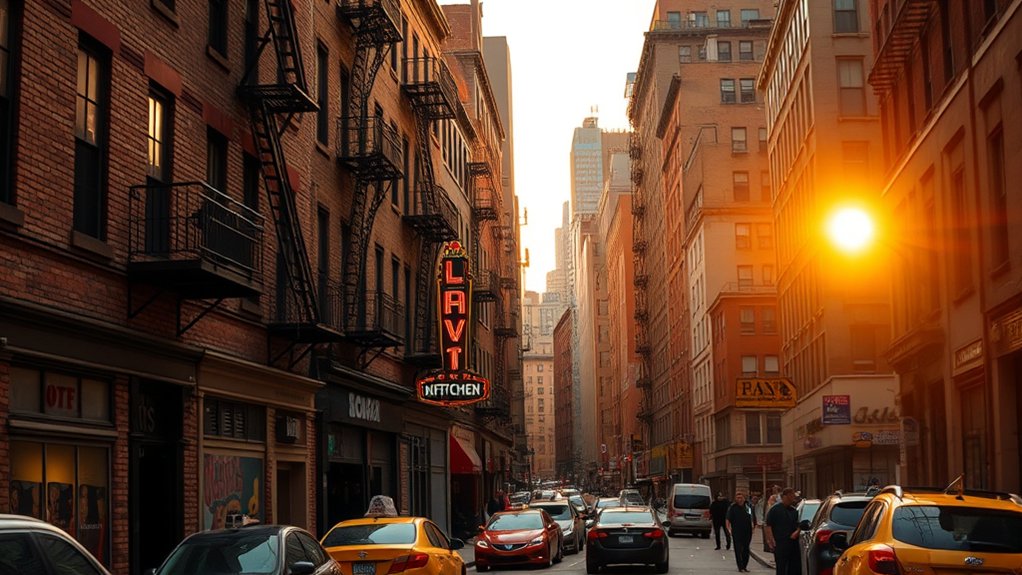
Located on Manhattan’s West Side, Hell’s Kitchen stretches roughly from Eighth Avenue to the Hudson River and from 34th Street to 59th Street. As you delve into the neighborhood, you’ll find it directly north of Chelsea and south of the Upper West Side. Midtown Manhattan borders its eastern edge, placing you within walking distance of Times Square, Hudson Yards, and the Theater District.
You can reach Hell’s Kitchen easily by subway, bus, or on foot. Major avenues, including Ninth, Tenth, and Eleventh, run through its mostly north-south street grid, while West 42nd, 49th, and 57th Streets provide convenient cross-town routes.
The Hudson River waterfront gives you open views, parks, and access to the Hudson River Greenway.
Cultural influences appear in the neighborhood’s restaurants, theaters, and longtime community spaces. Architectural landmarks include the Intrepid Sea, Air & Space Museum, historic row houses, and modern Hudson Yards towers, giving you a varied urban landscape to experience.
Why Did Hell’s Kitchen Gain a Violent Reputation?
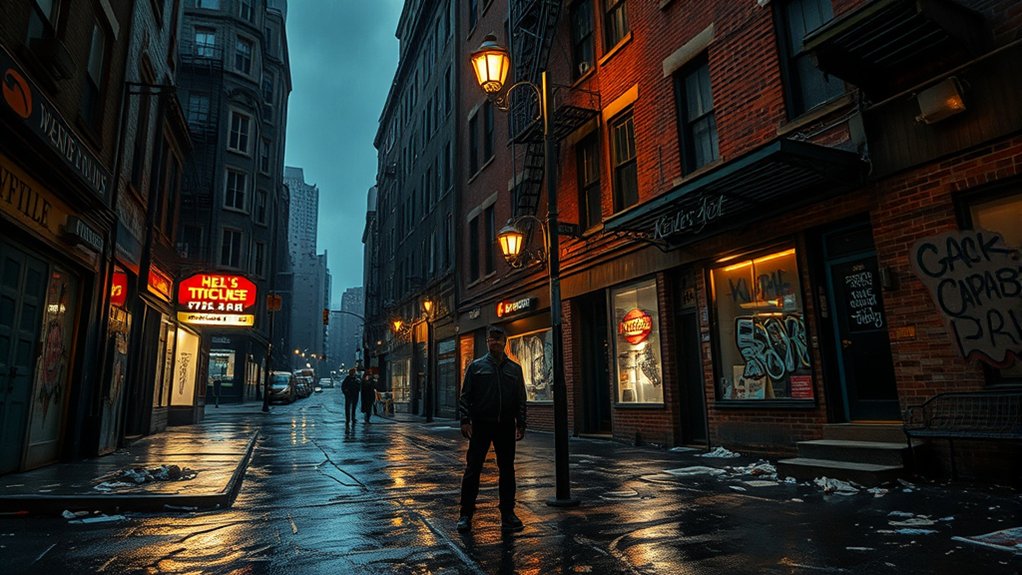
As you look into why Hell’s Kitchen gained such a violent reputation, you’ll find a history marked by gang clashes and turf wars. Overcrowded tenement buildings also created conditions that allowed crime to spread. Together, these forces made the neighborhood seem especially dangerous.
Gang Violence and Turf Wars
During the 19th and early 20th centuries, poverty, overcrowded tenements, and limited policing helped street gangs take root in Hell’s Kitchen. As you investigate the neighborhood’s past, you’ll find rival groups defending corners, docks, and routes connected to the Hudson River.
Turf disputes could quickly become violent, especially when gangs competed for control, protection, or local influence. Frequent clashes created fear and made the area seem more dangerous than neighboring districts.
Newspapers amplified that image, using sensational accounts of brawls and retaliation to attract readers. You can also see how these conflicts shaped Hell’s Kitchen’s cultural influence, feeding stories, songs, and later films about tough local characters.
They became part of its culinary history, too, as immigrant communities preserved food traditions despite instability. Over time, reform efforts and changing policing weakened gang power.
Crime in Tenement Blocks
Crowded tenement blocks helped give Hell’s Kitchen its violent reputation, as cramped rooms, poor sanitation, and scarce resources fueled disputes among residents. As you picture daily life, you’ll see how overcrowding made privacy impossible and turned minor disagreements into fights.
Unlit hallways, unsafe staircases, and limited police protection also gave thieves and gangs opportunities to operate.
| Condition | Effect |
|---|---|
| Overcrowding | Frequent conflicts |
| Poor lighting | Easier theft |
| Weak sanitation | Illness and tension |
| Limited policing | More disorder |
Yet residents weren’t simply criminals; most families worked hard and supported neighbors. Later, Community development brought services, housing improvements, and local advocacy.
Urban renewal eventually replaced many deteriorated buildings, though it also displaced longtime residents. These changes reduced visible crime, helping you understand how environment, not character alone, shaped Hell’s Kitchen’s violent image.
What Are the Main Origin Theories?
You’ll find two leading explanations for how Hell’s Kitchen got its name. One points to the fierce gang rivalries that shaped the neighborhood’s reputation. The other traces it to harsh conditions in historic tenements, where daily life was anything but easy.
Gang Rivalry Theory
The gang rivalry theory traces Hell’s Kitchen’s name to violent clashes among neighborhood gangs in the 19th century. You can understand the nickname as a warning about the area’s reputation for disorder, intimidation, and fierce territorial competition.
Some accounts connect it to rival groups that controlled streets, docks, or local businesses. Others suggest journalists and residents exaggerated the violence into a memorable label.
Because historians lack one definitive source, you should treat this explanation as plausible rather than proven. Later gentrification softened the neighborhood’s public image, yet the old name survived.
Today, the area’s culinary reputation contrasts sharply with its alleged criminal past. Restaurants and theaters draw visitors who may scarcely recognize the dangers once associated with Hell’s Kitchen.
The rivalry theory remains one interpretation among several competing explanations.
Historic Tenement Conditions
Another theory links Hell’s Kitchen’s name to the harsh conditions inside its crowded tenement buildings. If you walked these streets in the nineteenth century, you’d encounter overcrowding, poor sanitation, and constant noise. Families and newcomers endured urban decay while facing immigrant struggles, low wages, and limited services.
Those realities may have inspired a nickname comparing the neighborhood to a place of punishment.
Key conditions often associated with this theory included:
- Overcrowded apartments with little ventilation
- Shared toilets and unreliable clean water
- Dangerous fires and poorly maintained buildings
- Poverty, disease, and exhausting factory work
However, you shouldn’t treat this explanation as proven. Historians also connect the name to gang violence, nearby slaughterhouses, or colorful comparisons involving local police.
Tenement hardship likely shaped Hell’s Kitchen’s reputation, even if it didn’t create the name. The theory endures because it reflects how residents experienced daily life.
Did a Gang Inspire the Name Hell’s Kitchen?
Some accounts suggest that a notorious gang helped inspire Hell’s Kitchen’s name, but historians haven’t confirmed a single definitive source. As you investigate the neighborhood’s past, you’ll find several competing explanations rather than one proven story.
Writers sometimes linked the name to violence, while others credited harsh living conditions, a building, or a nearby social setting. Gang folklore may have strengthened the nickname, yet it doesn’t establish its origin.
| Possible influence | What it suggests | Historical certainty |
|---|---|---|
| Gang reputation | Violence shaped the nickname | Unconfirmed |
| Local landmark | A place carried the name | Uncertain |
| Broad folklore | Stories blended over time | Likely |
You should treat the gang theory as part of Hell’s Kitchen’s cultural memory, not settled fact. Later generations added their own associations through Culinary traditions and Music scenes, helping the name survive beyond its rough early image.
Because records conflict, you’ll get the clearest picture by comparing sources and recognizing that colorful legends often outlast reliable documentation. Avoid assuming a single gang definitively named the neighborhood.
What Was the “Hell’s Kitchen” Gang?
Although the gang theory remains unproven, it often points to the neighborhood’s violent reputation in the late 19th and early 20th centuries. “Hell’s Kitchen” wasn’t necessarily the name of one formally organized gang; it was a label writers and residents associated with tough local groups, street fights, and notorious tenements.
Hell’s Kitchen described a feared neighborhood culture more than one clearly organized gang, shaped by violence, poverty, and sensational reporting.
When you imagine this “gang,” think less of a single crew and more of a feared street culture shaped by rivalries, poverty, and sensational newspaper accounts. You’ll find references to:
- Loose neighborhood gangs protecting territory
- Fights near crowded streets and saloons
- Criminal figures amplified by reporters
- Stories repeated as urban legends
These groups likely had changing names and memberships, so identifying one official Hell’s Kitchen gang remains difficult. Newspapers and storytellers may have blended separate incidents into one dramatic image.
Over time, those accounts gained cultural influences from theater, film, and popular history, helping the gang idea survive. You shouldn’t treat the label as proof of a formal organization; it’s better understood as a shorthand for danger and disorder.
Did Tenement Life Create the Nickname?
Tenement life likely helped create the nickname by associating the West Side with overcrowding, poverty, noise, and frequent conflict. As you picture the area in the late nineteenth and early twentieth centuries, you can imagine families sharing cramped rooms, crowded courtyards, and narrow streets.
Tenement architecture packed residents into dense blocks, leaving little privacy and creating constant friction among neighbors. Poor sanitation, limited services, and exhausting work schedules added pressure to daily life.
Newspapers and visitors could then portray the community as unruly, reinforcing an image of danger and disorder. That reputation may have supported neighborhood branding, turning a vivid phrase into a memorable label for the district.
Still, tenement conditions alone can’t prove the nickname’s origin. Hell’s Kitchen appeared in several stories, and historians continue to debate which one came first.
You should thus treat housing conditions as an influence that made the name believable, rather than as definitive evidence of its creation.
Did Industry Inspire the Name Hell’s Kitchen?
Another possible source of Hell’s Kitchen’s name lies in its industrial roots. The neighborhood was once packed with factories, workshops, and a busy working waterfront. Given the harsh conditions, it’s easy to see how locals might have coined grim nicknames. Still, industry alone doesn’t provide a definitive explanation.
Industrial Roots and Nicknames
Industrial activity helped shape Hell’s Kitchen’s rough reputation, but it didn’t definitively give the neighborhood its name. As you investigate the story, you’ll find several nicknames competing with one another rather than a single proven explanation.
Heavy work, crowded housing, and street-level toughness may have encouraged comparisons to “hell,” yet historians still debate the exact origin.
- You’ll encounter competing origin stories.
- You’ll see how reputation shaped local language.
- You’ll find no official naming moment.
- You’ll understand why uncertainty remains.
Later, the neighborhood developed a Culinary reputation that softened its earlier image, while an Artistic community added another layer to its identity.
Those changes show why you shouldn’t treat one colorful theory as settled fact. Industry likely influenced how outsiders described Hell’s Kitchen, but the name emerged through rumor, memory, and repeated use, not a documented naming decision.
Its mystery remains part of the neighborhood’s enduring appeal.
Factories Shaping Hell’s Kitchen
Factories, warehouses, and slaughterhouses gave Hell’s Kitchen a gritty industrial character, but they didn’t definitively inspire the neighborhood’s name. As you examine its past, you’ll see workers, freight trains, and riverside piers shaping daily life.
Factories supplied jobs and smoke, while slaughterhouses added noise, odors, and dangerous conditions. These realities may have encouraged the area’s fierce reputation, yet historians still debate whether industry directly produced the nickname.
Through urban development, tenements crowded beside workshops, creating sharp contrasts between labor and poverty. Cultural influences also mattered: Irish immigrants, newspaper writers, police officers, and local storytellers helped spread colorful descriptions of the district.
You can understand why “Hell’s Kitchen” sounded believable without treating the factories as proof. Industry shaped the neighborhood’s identity, but its name likely emerged from several overlapping stories, not one definitive source.
Could the Draft Riots Explain the Name?
The 1863 New York City Draft Riots offer another possible clue to Hell’s Kitchen’s name, though no surviving evidence directly links the neighborhood’s nickname to the unrest.
If you picture Manhattan during those violent July days, you’ll see why later storytellers might connect danger, disorder, and the district’s grim reputation.
The riots erupted after the Union introduced a military draft, and working-class residents, especially Irish immigrants, attacked draft offices, Black New Yorkers, abolitionists, and wealthy targets.
Although much of the violence occurred elsewhere, fear spread across the city. Hell’s Kitchen already carried associations with poverty, crowded housing, saloons, and industrial hazards, so the unrest could have reinforced its image.
- You’ll notice how violence shaped public memory.
- You’ll see why rumors outlast records.
- You’ll recognize the power of neighborhood branding.
- You’ll understand the limits of this theory.
The Draft riots may have influenced later descriptions, but they don’t provide a documented naming moment.
Instead, they offer context for how Hell’s Kitchen’s reputation could grow darker over time.
Which Origin Story Has the Strongest Evidence?
Although several stories compete, the Hell’s Kitchen gang explanation has the strongest evidence because it appears in early accounts that connect the name with local violence and notorious figures. When you compare the alternatives, you’ll find that the gang theory relies on reported names, dates, and witnesses rather than colorful folklore alone.
Early accounts linking the name to local violence and notorious figures make the Hell’s Kitchen gang theory especially compelling.
Some accounts point to an especially feared local group, while others describe the neighborhood’s harsh reputation as “hellish.” The Draft Riots may have intensified that reputation, but they don’t clearly explain why the specific name endured.
Likewise, stories involving a tenement cook or a police officer add memorable detail without firm documentation. You should treat every version cautiously, since newspapers sometimes exaggerated crime for attention.
Still, the gang explanation best fits the period’s records and the area’s turbulent identity. Its cultural influence eventually outlasted the original criminals, shaping films, music, restaurants, and architectural landmarks that still define how you recognize Hell’s Kitchen today.
Frequently Asked Questions
What Is Hell’s Kitchen Called Today?
Today, you’ll usually find Hell’s Kitchen listed as Clinton, a Manhattan neighborhood just west of Midtown. Locals, businesses, and media still widely use “Hell’s Kitchen,” so both names remain current.
Historical origins explain the neighborhood’s older nickname, while official maps and city references often identify it as Clinton. You’ll also encounter the area through its Famous residents, restaurants, theaters, and lively Ninth Avenue dining scene today.
What Attractions Can Visitors Explore in Hell’s Kitchen?
Like a treasure map, Hell’s Kitchen guides you through lively streets packed with attractions. You can admire urban art, browse independent galleries, and catch performances at nearby theaters.
Delve into historic landmarks, including the Intrepid Sea, Air & Space Museum along the Hudson River. You’ll also find Restaurant Row, where diverse eateries serve global flavors, plus waterfront parks offering skyline views.
Don’t miss bustling Ninth Avenue for local shopping and nightlife.
How Has Hell’s Kitchen Changed Over the Past Century?
You’ll see Hell’s Kitchen transformed dramatically over the past century. Once a gritty, industrial neighborhood filled with rail yards, factories, tenements, and working-class families, it gradually experienced decline, redevelopment, and rising investment.
Historical evolution brought renovated buildings, luxury apartments, restaurants, theaters, and offices. Cultural influences remain visible through diverse communities, longtime businesses, LGBTQ+ landmarks, and immigrant traditions.
You can still find traces of its rough past amid today’s energetic, upscale streets.
Is Hell’s Kitchen a Safe Neighborhood for Tourists?
Yes, you’ll generally find Hell’s Kitchen safe for tourists, especially along busy avenues and near major attractions. You should use normal city precautions: stay aware of your surroundings, secure valuables, avoid poorly lit side streets late at night, and use licensed transportation.
Safety concerns can increase around quiet blocks after midnight, but serious incidents aren’t typical for visitors. The neighborhood’s restaurants, theaters, nightlife, and nearby tourist attractions make it a convenient Manhattan base.
What Restaurants and Cuisines Are Popular in Hell’s Kitchen?
You’ll find Hell’s Kitchen’s culinary scene bursting at the seams with culinary diversity. You can sample classic New York pizza, bagels, burgers, and Jewish deli favorites, then delve into Thai, Indian, Mexican, Ethiopian, Japanese, Korean, and Italian restaurants.
Broadway crowds often choose casual pre-theater spots, while rooftop lounges and steakhouses suit special occasions. Historical legends surround the neighborhood, but today’s eateries create its most delicious reputation, bite by bite, for visitors.
Conclusion
Hell’s Kitchen’s name remains a mystery, but you can understand why the neighborhood earned such a fierce reputation. Crowded tenements, dangerous streets, gangs, industry, and unrest all helped create its notorious image.
No single story proves the nickname’s origin, though local legends keep the debate alive. Today, you can walk through a far safer, livelier district that still preserves its gritty identity.
Curiously, Hell’s Kitchen covers roughly 100 city blocks, giving the history of how Hell’s Kitchen got its name plenty of room to unfold.